
Will Lawn Treatments Make My Grass Grow? What Richmond Hill Homeowners Should Know
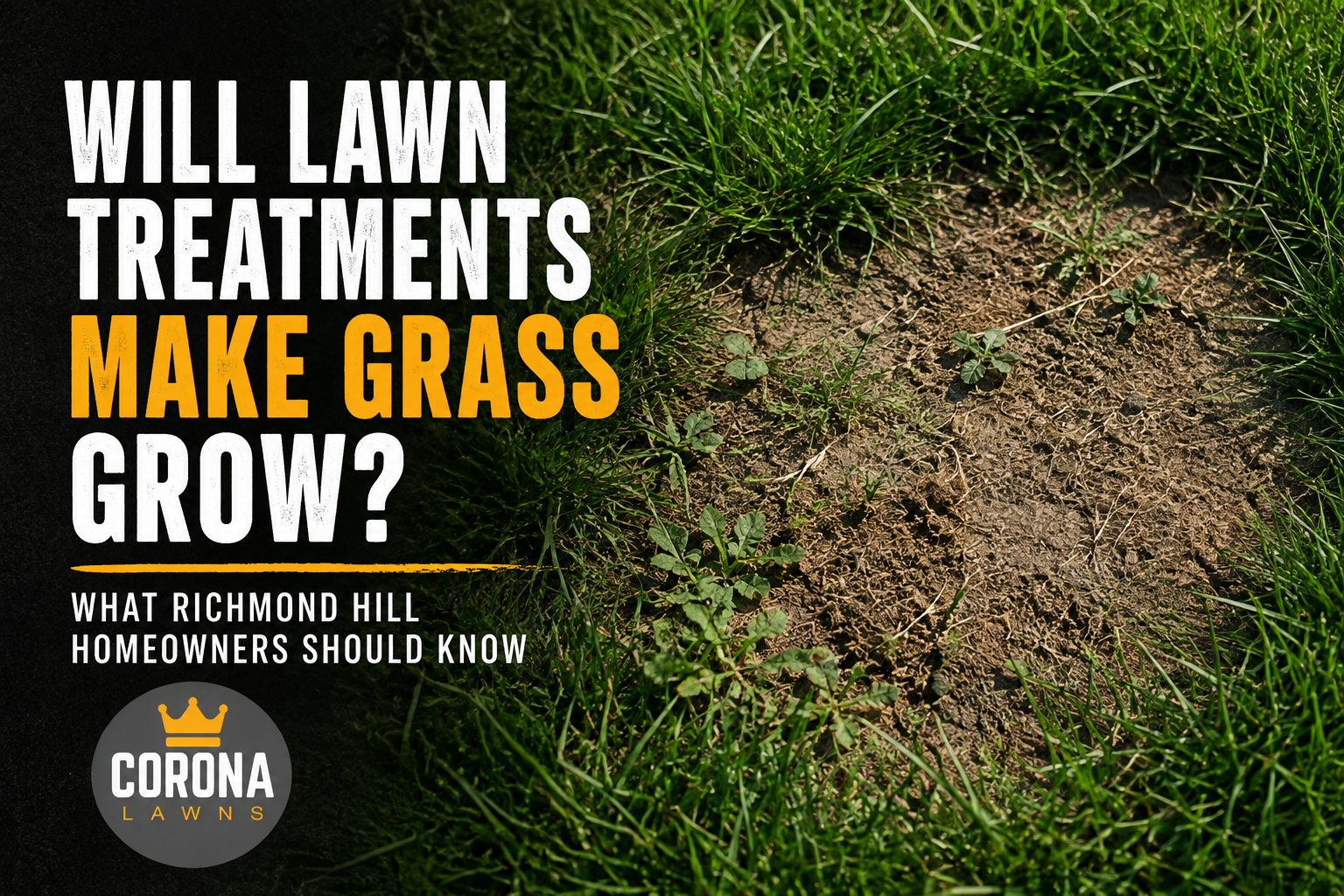
If your lawn has bare patches, thin areas, or sections covered in weeds, it’s easy to assume that a professional lawn treatment will make healthy grass start growing in those areas.
But there’s an important distinction homeowners should understand:
Lawn treatments can help create the conditions for a healthier lawn, but treatments do not grow grass where grass doesn’t exist.
At Corona Lawns, we want Richmond Hill homeowners to understand what’s actually happening in their yards and what they can realistically expect from professional lawn care.
What Do Lawn Treatments Actually Do?
Professional lawn treatments can serve several purposes depending on what your lawn needs. They may help control weeds, provide nutrients, address certain pests or diseases, and support the health of your existing turf.
That can make an enormous difference in the appearance and overall health of a lawn.
What treatments cannot do is create grass plants out of bare soil.
If an area of your yard has little or no existing grass, spraying or treating that area will not suddenly cause new grass to appear. New grass has to come from somewhere, whether that means existing turf gradually spreading into the area or installing new sod.
Our lawn care and landscaping services are designed around what your property actually needs rather than treating every lawn the same way.
Why Do Bare Spots Sometimes Appear After Weed Treatments?
This is another situation that can surprise homeowners.
Imagine looking across your yard and seeing green coverage everywhere. Unfortunately, some of that green may not be grass at all. It may be weeds.
When those weeds are successfully eliminated through a lawn treatment program, the area they occupied becomes visible as bare soil.
The treatment didn’t create the bare spot. It revealed an area where weeds had been growing instead of healthy turf.
This can actually be a sign that the weed treatment is doing its job. The next question becomes what to do with the newly exposed area.
If you're unsure whether you're looking at healthy turf, weeds, or a combination of both, the team at Corona Lawns in Richmond Hill, GA can help determine the best approach for your property.
Bare Soil Rarely Stays Bare
Nature likes to fill empty space.
When a large area of bare soil is left alone, something will eventually begin growing there. Unfortunately, that "something" is often another round of weeds.
Weeds are opportunistic and can quickly take advantage of open areas where there is little competition from healthy turf. That's why simply eliminating weeds may only be part of the solution when a lawn has significant bare areas.
To actually turn that space into lawn, grass needs to be established there.
Will My Existing Grass Eventually Fill In?
Possibly, but patience is important.
Many of the warm-season grasses commonly found in our area can spread into nearby bare areas over time. How quickly that happens depends on the grass variety, size of the bare area, growing conditions, sunlight, watering, soil health, and other factors.
For a small thin spot, allowing healthy surrounding turf to gradually fill in may be reasonable.
For a large bare section, however, relying on existing grass to spread could take a very long time. In some situations, it can take years to achieve the coverage a homeowner is expecting.
That's where sod installation may make much more sense.
Treat the Problem, Then Rebuild the Lawn
A healthy lawn sometimes requires more than one solution.
First, we need to understand why weeds took over or why healthy grass disappeared in the first place. Then we can address the underlying lawn-care issues and determine the best way to restore turf in areas where grass is missing.
For larger bare areas, installing sod can provide actual grass coverage rather than waiting and hoping surrounding turf eventually fills the space.
The important thing is having realistic expectations: weed control removes weeds. Lawn treatments support healthy turf. Sod or natural turf growth establishes grass where grass is missing.
They work together, but they aren't the same thing.
If your Richmond Hill lawn is struggling with weeds, bare areas, thinning turf, or you're simply not sure what it needs, contact Corona Lawns and let us take a look. We'll help you determine what your lawn needs now and what will give it the best chance to stay healthy moving forward.
